One of the coolest things to happen in coffee in recent years is the proliferation of options for home espresso. Once exclusive to people with a fair amount of disposable income, things like the Flair, Wacaco Picopresso, Rok, and others have made excellent espresso at home much more accessible and easy.
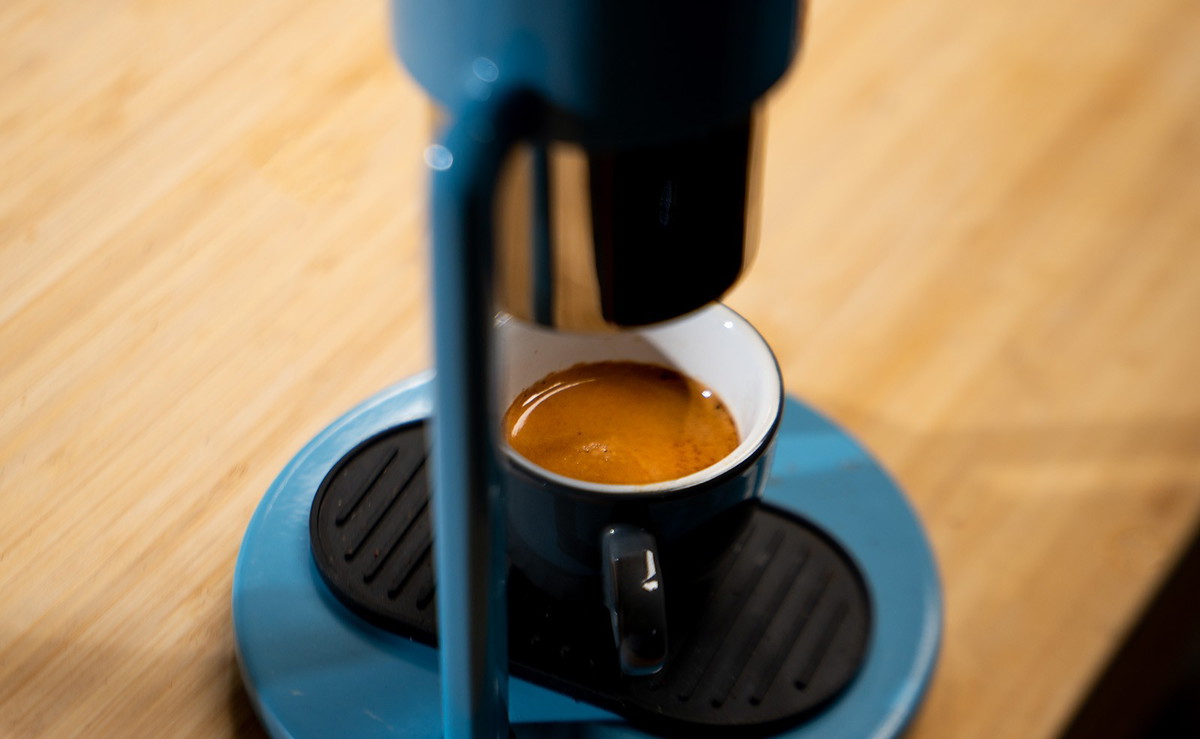
The Cafelat Robot is one of those machines. Utilizing pressure gained from pushing down evenly on two arms, the Robot is capable of making very tasty espresso shots without the need for a pump and without the use of much counter space. The Robot has gained fans worldwide for its strong craftsmanship, ease of use, and charming looks.

Manual machines like this also come with a cool side effect: the user can tweak the pressure put on the espresso puck at will, something only much more expensive auto machines can accomplish.
In the espresso recipe below, we use this feature to our benefit to create a shot that has a bit more clarity and acidity than a traditional 9-bar shot.
THE CAFELAT ROBOT DECLINING PRESSURE ESPRESSO SHOT
The recipe below can be laid out in four stages:
- A 2 bar pre-infusion
- A ramp up to 9 bars for 50% of total output (20 mL)
- A ramp down to ~6 bars for about 10 mL
- A final ramp down to ~3 bars for about 10 mL
The included pressure gauge is very helpful here — and maybe even a necessity — and so is a scale. If your model doesn't have this gauge, you can probably make it work by simply lowering the pressure you put on the puck throughout the shot; you just won't have the numbers to reference.
What is pre-infusion?
A pre-infusion is essentially getting the espresso puck wet via low pressure for a certain length of time to help with even extraction. Instead of immediately pushing down at the traditional 9 bars of pressure, we go up to about 2-3 bars to slowly infuse the coffee puck with water. If your grind is about right, drips will start coming out around 10 seconds in.
Why declining pressure?
Espresso is incredibly complex and all sorts of factors come into play for the final taste you experience. Traditionally espresso has always been done at 9 bars, and the SCA even worked this into their official definition of espresso. But pressure is another tool in your kit for extracting different nuances from your coffee, and here we are using the Robot's ability to change pressure to get different texture and clarity out of your coffee. We usually notice a lighter body with more perception of acidity.
THE BEST SCALE FOR THE CAFELAT ROBOT
One of the main complaints for the Robot is that most scales don't fit between its bars. We found a cheaper one on Amazon that fits great, has a built in timer, and has a really great response time.

Link to Buy Maxus Scale (not an affiliate link)